



After the Houston City Council approved a revised policy governing how municipal police officers interact with federal immigration agents on Wednesday, key players differed in their interpretation of what the change means.
The original ordinance, passed two weeks earlier, prohibited Houston Police Department (HPD) officers from detaining people or prolonging traffic stops due to civil administrative warrants issued by U.S. Immigration and Customs Enforcement (ICE) – which has ramped up deportations in Texas and across the country under President Donald Trump.
The revision changed the definition of administrative warrants. The original ordinance said they “are not reviewed by a neutral magistrate or judge and are not probable cause for a criminal arrest.” The updated ordinance described them as “commanding the arrest of an individual either to conduct removal proceedings or for removal.”
The change also stripped the word “only” from the original directive that “officers may temporarily detain an individual only as long as reasonably necessary to complete the legitimate purpose of the initial stop or investigation.” And it added the phrase, “and for other legitimate purposes discovered during the detention.”
Even with the revision, the core of the original ordinance remained intact, City Attorney Arturo Michel told Houston Public Media before the vote on Wednesday.
“A person can be detained for the time needed to conduct the state law criminal investigation," Michel said. "So, in that sense, the original ordinance — that purpose remains the same.”
Michel is wrong, Houston Police Officers' Union president Douglas Griffith told Houston Public Media after the vote.
"It’ll be more of a case-by-case basis," Griffith said. "What this does is gives us a reasonable amount of time to determine whether this is someone that ICE wants or they don’t. There will not be a limit on time."
Under questioning from council member Alejandra Salinas — who spearheaded the original measure and opposed the revision — Mayor John Whitmire said the change allowed officers and their supervisors to consider "the totality" of a situation.
"I think we have language that’s deliberately ambiguous so that it can mean what various groups want it to mean," said Seth Chandler, professor at the University of Houston Law Center. "The real issue is going to be what actually happens on the ground."
Whitmire's revision came after Texas Gov. Greg Abbott threatened to revoke about $114 million in public safety grants unless the original ordinance was reversed. Attorney General Ken Paxton also launched a lawsuit, accusing the city of violating Senate Bill 4 — the 2017 state law prohibiting cities from curtailing collaboration between police departments and ICE.
Houston's legal department and Abbott's office of public safety worked together on the revision over the past two weeks, according to Whitmire.
"Our city attorney talks to the governor’s criminal justice department," Whitmire told Houston Public Media on Friday. "(Michel) talks to numerous players. We talk to the (Texas Department of Public Safety). We talk to stakeholders that want us to follow Senate Bill 4. And sometimes, obviously, there’s a disagreement about what Senate Bill 4 requires. But there’s no doubt if we don’t follow Senate Bill 4, as we have right now, we’ve lost $114 million."
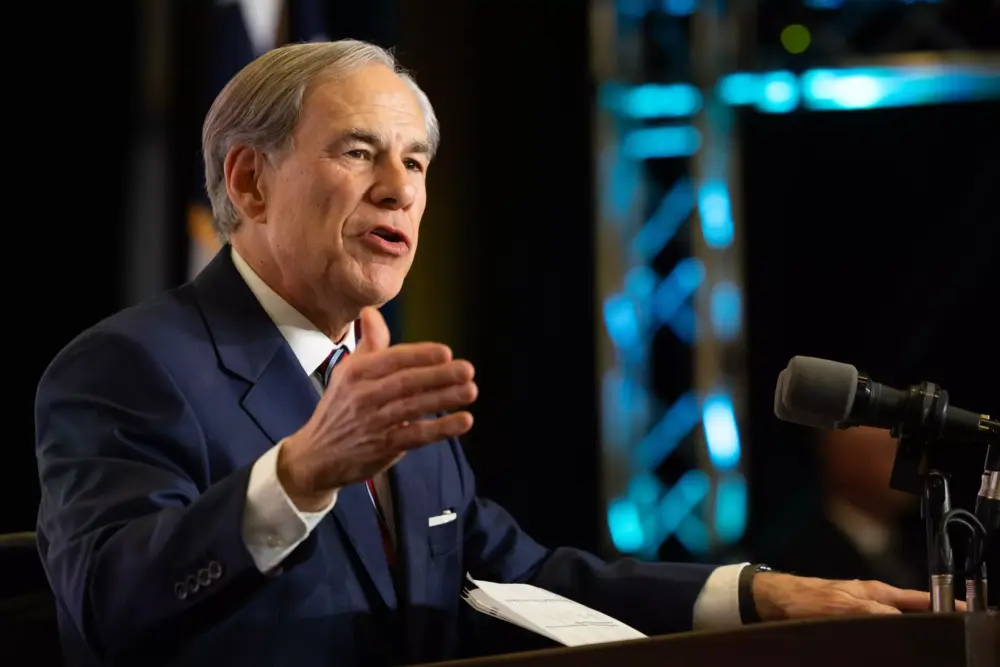
In comments to Fox News, Abbott implied Michel's interpretation of the revision was problematic.
"There’s a big controversy swirling about (whether HPD will be compliant) because it comes from comments made by the city attorney apparently to appease the city council for the vote that they took," Abbott said.
“If the Houston Police Department does not … detain any illegal immigrant they encounter and … notify DHS of the encounter, then the city and the police department still stand to lose the $110 million," the governor added.
A spokesperson for Whitmire did not answer a question about whether he stands by Michel's comments. ICE did not respond to requests for comment.
In a department directive issued Thursday, HPD enabled its officers to “wait a reasonable amount of time” for ICE to “obtain custody” of people with civil immigration warrants.
Abbott, city officials and HPD were "all tap dancing around a central question, and that’s what constitutes a legal but compliant stop," said Brandon Rottinghaus, a political science professor at the University of Houston.
"What is written down at City Hall may not always translate into what exactly happens on the ground," Rottinghaus said. "There is an implementation issue that happens in every bureaucracy like this."
Even after the original ordinance passed, HPD's policy had remained unchanged until Thursday. In a previous directive to officers — first reported by the Houston Chronicle and independently obtained by Houston Public Media — department leadership said traffic stops and detentions could be extended by up to 30 minutes due to civil immigration warrants.
The former directive was issued on April 11, three days after the city council approved the measure prohibiting officers from detaining people due to civil immigration warrants.